Home/Smart 2 Print Heads 720 Dpi Uv Digital Flatbed Printing Machine Auto Cleaning
Factory direct product
Smart 2 Print Heads 720 Dpi Uv Digital Flatbed Printing Machine Auto Cleaning
Smart 2 Print Heads 720 Dpi Uv Digital Flatbed Printing Machine Auto Cleaning. from Beijing, China.
Get the latest price
Product specifications
Technical details
Place of Origin
Beijing, China
Brand Name
WallNova
Certification
RoHS for ink
Product Overview
The Smart 2 Print Heads 720 Dpi Uv Digital Flatbed Printing Machine Auto Cleaning is a versatile multifunction flatbed printer built for high-quality UV digital printing on flat and rigid substrates. Key features include 720 DPI high-resolution output, 2 printhead configuration, UV LED ink curing system, automatic printhead cleaning.
Key Features
720 DPI high-resolution output
2 printhead configuration
UV LED ink curing system
automatic printhead cleaning
RoHS for ink
Applications
This flatbed printer is designed for printing on floor tiles, ground decoration, garage floors, glass panels, metal sheets, wood boards, ceramic tiles, and other rigid flat materials. It is widely used in advertising, interior decoration, packaging, and industrial product marking.
Technical Advantages
As a WallNova product, the Smart 2 Print Heads 720 Dpi Uv Digital Flatbed Printing Machine Auto Cleaning benefits from rigorous quality control, CE-certified machine construction, and RoHS-compliant ink systems. The printer features a robust frame design, precision guide rails, and an intuitive control interface that simplifies operation for both experienced technicians and new operators.
The ink system is engineered for consistent color output and long-term reliability. Depending on the configuration, the printer supports either water-based eco-friendly inks (low odor, suitable for indoor use) or UV-curable inks (fast curing, suitable for a wider range of materials including non-porous surfaces).
OEM / ODM Customization
WallNova offers comprehensive OEM and ODM customization for the Smart 2 Print Heads 720 Dpi Uv Digital Flatbed Printing Machine Auto Cleaning. Customers can specify custom machine colors, printing widths, printhead configurations, ink systems, and software interfaces to match specific project requirements. Minimum order quantities and lead times vary by customization level — contact our team for a detailed quotation.
Consolidated technical specifications
Smart 2 Print Heads 720 Dpi Uv Digital Flatbed Printing Machine Auto Cleaning
Three of the four descriptors in this title are claims without figures. Smart names a character, 2 Print Heads names a count, Auto Cleaning names a behaviour, and only 720 Dpi is a number. The listing records no model number, so nothing on a nameplate can be matched to the title; identification runs through WallNova, the platform reference 14494978 and the configuration schedule.
Field
Recorded value
Product designation
Smart 2 Print Heads 720 Dpi Uv Digital Flatbed Printing Machine Auto Cleaning
Model Number
Not stated in this listing
Brand Name
WallNova
Place of Origin
Beijing, China
Platform reference
14494978
Category placement
Listed on this platform under multifunction flatbed printer
Designation descriptors
Two-printhead descriptor, resolution descriptor, digital flatbed descriptor, cleaning-function descriptor, as stated in the product name
Conformity scope
RoHS for ink. A machine-level CE declaration is not stated in this listing.
720 Dpi is the lowest resolution among the flatbed listings in this group, and the storefront text describes the same figure as high-resolution output. Both can hold at once: the figure is fine enough for large work seen from a distance and coarse for small type inspected closely. What the listing never gives is the print mode the figure belongs to, and a resolution without a mode cannot be turned into a production rate.
Positioning within the flatbed and ground range
Two printheads widen the swath covered per pass and can carry separate colour channels, which is why head count appears in the title alongside resolution rather than instead of it.
A 720 dpi grid is a working figure for large-format ground and panel work. At normal viewing distance it trades fine detail for throughput, and that trade should be agreed before the order rather than discovered at acceptance.
Automatic printhead cleaning is a maintenance function. It protects the nozzle plate during idle periods, and its cycle length belongs in the handover checklist so that a later fault can be traced to a change in routine.
Two heads, one resolution, three unknowns
What a head count and a dot pitch each decide
A head count fixes how the ink reaches the substrate; a resolution fixes how finely it is placed. Neither alone predicts what a job looks like, and this listing supplies the two without the arrangement or the mode that would join them together.
Configuration item
Record basis for this unit
Buyer confirmation point
Model identity
The listing records no model number, and the title follows the same pattern as other units in the family
Tie the platform reference 14494978 to the serial on the invoice and on the packing list.
2 Print Heads
A count with no channel map: nothing says whether the heads carry different colours, the same colour twice, or two adjacent slices of one image
Request the channel map and the physical spacing between the two heads in millimetres.
720 Dpi
A resolution with no axis and no print mode; dividing 25.4mm by 720 gives a nominal dot pitch near 35 micrometres, which is addressability rather than visible detail
Have the figure restated against a named axis and the pass configuration it applies to.
Smart
A characterisation rather than a function; no control feature, sensor or automation is named anywhere in the listing
Ask for the feature list and treat every function absent from it as absent from the machine.
Auto Cleaning
A behaviour with no trigger: neither an interval, a cycle count nor an event is defined, and no ink or waste consequence is given
Establish what starts the cycle, what it consumes and where the cycle is logged.
Of the five items only the resolution can be checked against a delivered sample. The other four can be answered in writing before the order is placed, which is where they belong.
Stitch line, dot pitch and cleaning cycles
Where a two-head 720 Dpi machine earns or loses a job
Two heads either widen coverage or deepen colour, and in both cases the place where their output meets is the machine's weakest line. A dot pitch near 35 micrometres sets what a file can ask for; the substrate decides what survives; the head-to-head join decides what an eye notices first.
Area
What this machine imposes
Verification action
Head-to-head stitch
Two heads are aligned mechanically, and any residual offset between them shows at the junction as a darker or lighter band that repeats at a fixed interval across the whole job
Print a solid mid-tone across the join and walk the seam end to end before the alignment is approved.
Pitch against drop spread
At 720 Dpi the addressable grid is finer than a UV drop spreads on a coated panel, so the grid stops being the limit and dot gain plus edge raggedness take over
Judge a printed 6mm character first at the distance the work will be read from and then at arm's length, recording both.
Resolution as a throughput decision
Fewer passes at a lower addressable resolution yields more square metres per hour from the same hardware, so the low figure buys area rate wherever the artwork tolerates it
Build two production recipes, one for distance-viewed panels and one for close-viewed work, and time each over a full sheet.
Automatic cleaning and the cap
A cycle on a short timer can fire mid-job, while a cycle on a count will not fire during a long idle period; each choice trades ink wasted against nozzle risk
Learn the trigger, then log one shift and compare the ink spent on cleaning with the ink spent on print.
Wiper and waste handling
Cleaning moves ink somewhere, into a cap, onto a wiper or into a waste container, and an uninspected wiper fouls and then smears across the head
Name who inspects the wiper and empties the waste, and put both on the daily start-up sheet.
Two heads, two failure signatures
With two heads an intermittent nozzle appears as a repeated line at a fixed spacing rather than as a random defect, and the spacing itself identifies which head is responsible
Keep the commissioning nozzle check on file so a later line can be compared with a known-good pattern.
Dot gain, adhesion and light-fastness are evaluated by methods from the ASTM and ISO families, chosen for the actual substrate and market. No pass count, area rate or ink consumption figure is published for this machine, so the numbers above describe arithmetic and workshop practice rather than measured performance.
Product description and image documentation
Complete product image set
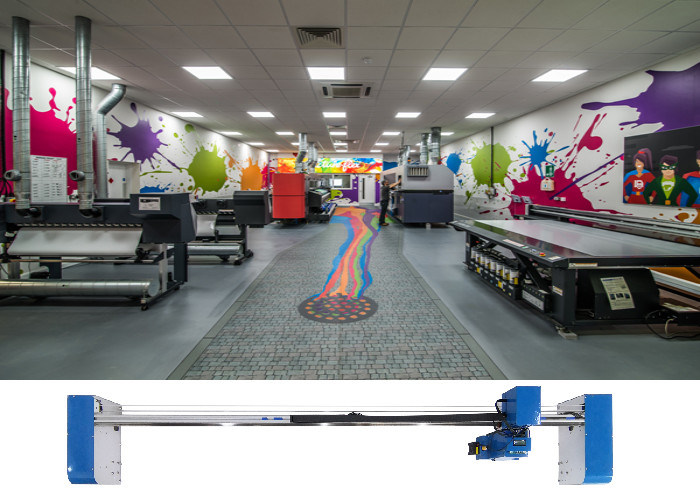
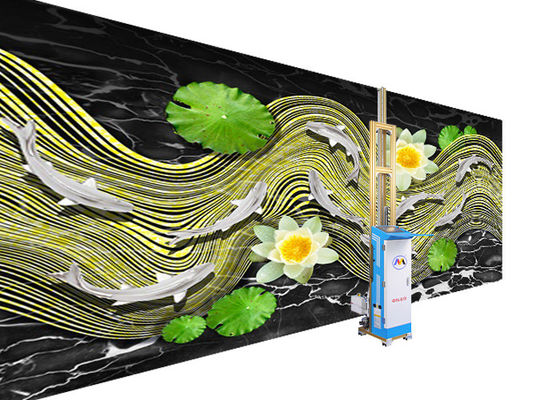
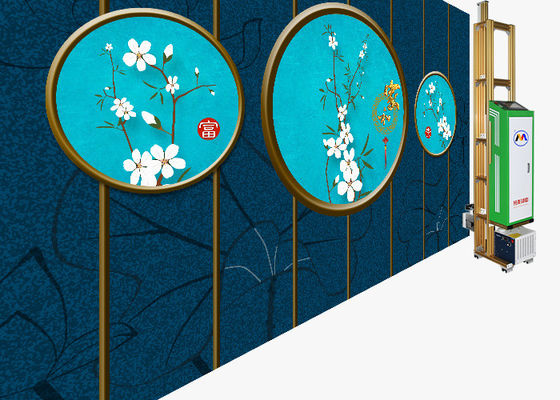
Four views of this unit are held on the platform under reference 14494978 and are displayed below at their intrinsic aspect ratios. Any view can be enlarged, and Previous and Next or the arrow keys move between the four.
View 01 / 560 x 400View 02 / 560 x 400View 03 / 560 x 400View 04 / 700 x 500
These four views are the complete set held for reference 14494978. File names are unchanged from the media library, so each frame can be checked against the listing record it came from.
WallNova is presented on this platform as a digital wall printing technology manufacturer, with place of origin Beijing, China and a service address published in Longhua District, Shenzhen. The company information identifies a supplier; it does not describe the head arrangement, the cleaning logic or the print mode of the unit in this listing.
Brand
WallNova
Positioning
Digital Wall Printing Technology
Product origin
Beijing, China
Contact address
Longhua District, Shenzhen, China
Service hours
8:30-17:30 (China time)
Business scope
Direct-to-wall printing systems
Conformity scope and qualification
Qualification aspect
Scope statement
Machine conformity
Assessed for the shipped model and the regulatory requirements of the destination market.
Ink conformity
Assessed separately from the machine, against the ink set supplied with the order.
Certificate applicability
Certification depends on the actual product model and target market.
Documentation control
Documents are issued against the delivered configuration schedule and the named contracting entity.
The published specification for this unit is limited to origin, brand and an ink-scope RoHS record. All four descriptors in the title therefore rest on the product name alone, which is why each should be converted into a written answer rather than carried into a quotation unchecked.
Questions about 720 Dpi and automatic cleaning
What the lowest resolution in the family can still do
These are the questions a buyer asks when the number looks small and the word Smart looks large.
Is 720 Dpi enough for a printed floor graphic?
For a graphic read from two metres or more, yes: the grid is finer than the eye resolves at that distance, and the substrate's texture will decide the visible edge well before the head does. For small type, fine line work or a logo that will be inspected at arm's length it is the wrong machine, and no amount of file preparation changes that.
Then why is 720 Dpi described as high resolution?
Because the phrase is comparative and the comparison is left out. Against a large-format banner press the figure is ordinary; against a hand-stencilled floor it is fine. Read it as a statement about machine class and check it against the viewing distance of the job rather than against the adjective.
What are the two heads doing?
The listing does not say. They could split four colours across two bodies, double the density of one colour, or cover two adjacent slices of the image. The arrangement governs seam behaviour, ink consumption and what a single head failure costs, so it belongs in the quotation rather than in an assumption.
When does auto cleaning run?
Undefined in the listing. Timed cycles, count-based cycles and cycles prompted at idle or at shutdown all exist, and they differ both in ink consumed and in the protection offered during a long pause. Ask for the trigger and for the log, then read the log after a week of real work rather than a demonstration.
Does the cleaning cycle replace a daily nozzle check?
No. A cycle restores a head that has partly dried, while a nozzle check shows whether it worked. The check print is also the reference needed later, because a repeated defect at fixed spacing points at one head, and without a known-good print there is nothing to compare it with.
What certification does the unit carry?
The specification table records RoHS for ink, which is scoped to the ink. Certification depends on the actual product model and target market. A machine-level document for a specific destination therefore has to be requested separately and matched to the serial actually shipped.
Print trials that expose the stitch
Six things to test rather than read
A two-head machine can pass every documentary check and still fail at the join. These trials are chosen to make that failure visible before acceptance.
Check
What this unit requires
Record to hold
Channel map
The role of each head is written down together with the spacing between them.
Head assignment schedule
Stitch trial
A solid mid-tone has been printed across the join and inspected along its full length.
Signed trial print
Viewing test
The smallest type in the intended artwork has been read at the real viewing distance and again at arm's length.
Approved sample
Cleaning log
The trigger is known and one shift of cycles has been recorded with the ink used.
Machine log
Nozzle baseline
A commissioning nozzle check is filed as the reference pattern.
Handover file
Mode statement
The pass configuration behind 720 Dpi is named for each production recipe in use.
Recipe and mode sheet
The stitch trial and the viewing test between them answer the two questions this title raises. The remaining four keep those answers valid over the following months.