
Direct from manufacturer
90V 246V Vertical Wall Printer Robot
- Place of Origin
- Beijing, China
- Brand Name
- WallNova
- Certification
- CE for machine, RoHS for ink


Factory direct product
High Resolution WallNova 15-30cm Cylinder Uv Printer. from Beijing, China.
Product specifications
Consolidated technical specifications
The title is reproduced with its word order and capitalisation intact. Three values are published for this unit, namely brand, origin and one ink-level conformity record, and no performance table accompanies them. Everything below therefore treats High Resolution and the 15-30cm bracket as name-level descriptors and confines the engineering discussion to what a cylindrical UV machine of that description can and cannot reasonably be asked to do.
| Field | Recorded value |
|---|---|
| Product designation | High Resolution WallNova 15-30cm Cylinder Uv Printer |
| Brand Name | WallNova |
| Place of Origin | Beijing, China |
| Certification | RoHS for ink |
| Product family | Cylinder UV printer |
| Platform reference | 14102913 |
| Designation descriptors | High Resolution quality descriptor and 15-30cm workpiece descriptor, both as stated in the product name |
| Conformity scope | The record covers the ink only, with no machine-level document listed for this unit. Certification depends on the actual product model and target market. |
The 15-30cm bracket is the only dimensional statement in the record, and it arrives without a named dimension. Whether it bounds a printable diameter, a printable length or the outside size of the objects the fixture will accept decides which jobs this machine can take, so it is the first item a quotation has to make specific.
Reference model series and configuration boundaries
There is no model number in the published record for this unit, only a brand and a reference, so the reference number has to do the work a model number would normally do. Two machines can both be sold as a WallNova cylinder UV printer at 15-30cm and still differ in head count, ink chemistry and fixture design. The rows below separate what the name locks from what the order has to state.
| Configuration item | Record basis for this unit | Buyer confirmation point |
|---|---|---|
| Workpiece bracket | 15-30cm written into the name, with the dimension left unnamed | Ask which dimension is bounded, then have the answer written onto the order rather than inferred from the title. |
| Quality descriptor | High Resolution with no dpi figure attached anywhere in the record | Require a head-native resolution plus the pass count used for the sample, since a quality word cannot be compared between suppliers. |
| Ink and conformity | RoHS recorded for the ink, chemistry not stated | Confirm whether the supplied set is a general-purpose UV-curable ink or one formulated for a specific substrate family. |
| Fixture and mandrel | Set by the order, not by the product name | List every object diameter to be run in production and require a matching mandrel for each before dispatch. |
| Colour channels | Not stated in the published record for this listing | Fix channel count in the configuration schedule so that a later ink or head change counts as a revision. |
| Automation scope | Not stated in the published record | Establish whether loading, indexing and unloading are machine functions or operator functions before pricing labour. |
| Curing arrangement | Not stated in the published record | Ask for lamp type, lamp count and the curing distance held during acceptance; all three affect hardness. |
An order that says only WallNova cylinder UV printer at 15-30cm is ambiguous in three places at once, namely the dimension, the resolution and the fixture. Quoting the platform reference alongside those words settles which listing is meant, though it does not settle the ambiguity that sits inside the listing itself.
Engineering practice for a small-format cylinder unit
A cylindrical UV printer is a rotary axis bolted to a linear gantry, and the rotary axis is the half that buyers underestimate. The four notes below are the ones that decide whether a machine of this size earns its floor space, and each is answerable before an order is placed.
If 15-30cm describes printable diameter, the machine is built around a mandrel range. Objects below the lower bound cannot be gripped concentrically, and objects above the upper bound foul the carriage or the head guard. A bottle outside that range does not print badly, it does not print at all, because there is no way to hold it true to the axis.
If the same figures describe printable length along the axis instead, the constraint moves to the label field and the object's total height becomes irrelevant as long as it clears the head. The two readings point at different machine designs, and a supplier who cannot say which one applies is describing a price bracket rather than a specification.
Resolution on a cylinder has two axes and they are not equal. Around the circumference the limit is set by how finely the rotary axis steps between passes; along the axis it is set by the head width and the carriage speed. A machine can quote an impressive figure on one axis while the other is what a customer actually sees on a finished container.
Because no dpi value appears anywhere in the record, the useful comparison question is not how sharp the output claims to be but how many passes the supplier needed to produce the sample. Two suppliers using the same quality word can be three passes apart, and on a short-run label job that gap is the entire cost structure.
On a 60mm bottle one millimetre of arc is under two degrees of rotation, and the print zone of the head is flat while the surface is not. The gap between nozzle plate and substrate therefore changes across the zone unless the head is tilted or the fixture compensates, and the visible symptom is a soft edge on fine type rather than an obvious defect an operator would catch.
That is why small-diameter work rewards a slower rotary step more than a higher head resolution, and why a buyer moving from flatbed printing to cylinders should test fine text at the smallest diameter in the range before accepting any quality claim in writing.
RoHS for ink describes what is inside the ink and says nothing about how well it grips. On glass, glazed ceramic and brushed metal the failure mode is not smearing but flaking at a scrape or after a wash, and it usually appears days after the job has been signed off and the containers have been filled.
The mitigation is a pretreatment or a primer matched to the substrate, and both shift the colour result, so they belong in the qualification run rather than in a complaint raised after delivery.
None of these four items needs a measurement the supplier does not already hold. They are simply the values a name-level listing omits, and every one of them is cheaper to settle while the quotation is open than during the first production week.
Product description and image documentation
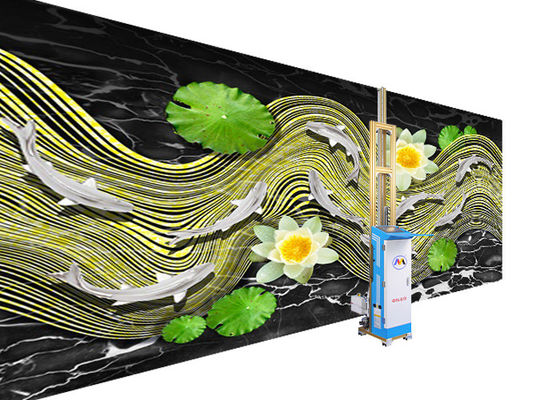
Four views of this unit are held on the platform under reference 14102913 and appear below at their intrinsic aspect ratios. Select any view to open the enlarged viewer; Previous and Next or the arrow keys move through the set.


The four views above are the complete image set held for reference 14102913. File names are unchanged from the media library so that any view can be traced back to the listing record. The set documents the machine as offered, not a printed cylinder, and it should not be read as evidence of output quality.
Independent manufacturer overview
WallNova is presented on this platform as a manufacturer of digital wall printing technology, with this unit built in Beijing and the commercial contact point in Shenzhen. The identification data below describes the supplier entity; the delivered configuration of this machine is fixed by the order schedule instead.
| Qualification aspect | Scope statement |
|---|---|
| Machine conformity | Not listed for this unit; the published record carries an ink-level document only. |
| Ink conformity | RoHS recorded for the ink set, assessed separately from the machine itself. |
| Certificate applicability | Certification depends on the actual product model and target market. |
| Documentation control | Documents are issued against the delivered configuration schedule and the named contracting entity. |
A supplier holding both machine and ink documents will normally list both, so a single ink entry suggests that the ink document is the one issued for this configuration. Buyers who need a machine-level document for import should request it explicitly and check that it names the shipped unit rather than the product family.
Questions this configuration actually raises
The questions below follow from this particular designation rather than from procurement in general. Payment terms, packing and freight are answered in the quotation and are not repeated here.
The record does not say. It is the only dimensional figure in the listing, and it can plausibly mean printable diameter, printable length along the axis, or the outside size of the objects the standard fixture accepts. Ask the supplier to state the dimension in writing, because the answer decides whether your container range fits at all.
Some listings in this catalogue carry only a brand and a reference. That makes the platform reference 14102913 plus the configuration schedule the identifying pair, and it means a supplier cannot be asked to ship a named model. Quote the reference on the order and on the packing list so the delivery can be checked against the listing that was priced.
No dpi figure is published here, so the phrase is a positioning statement rather than a measurable claim. Ask for the head's native resolution, the pass count used for the demonstration sample, and the substrate the sample was printed on. Those three values compare across suppliers; the quality word does not.
A rotary axis holds a surface of revolution, so a tapered body changes the standoff as it turns and an oval body changes it twice per revolution. Both can sometimes be handled with a shaped fixture, but that is a fixture engineering project rather than a standard option, and it should be quoted as one before production volumes are promised to a customer.
Within the stated range, yes in practice. A mandrel that grips one diameter will not centre another without a sleeve, and a sleeve that is not concentric introduces run-out that shows up as a band in the print. The number of stock diameters you intend to run is therefore a direct cost input, not an accessory detail.
The listing records RoHS for the ink, which is a substance-compliance document, and lists no machine-level conformity record for this unit. Certification depends on the actual product model and target market, so a buyer needing a machine document for customs or for a client specification should ask for it by name and check that the shipped unit is the one covered.
At least two panels: one on the smallest diameter in your range and one on the largest, both on your own containers with your own artwork. Check fine text, colour against a proof, and adhesion after a scrape and a wash. Keep one panel and one retained ink sample, because they are the only baseline available if a fault appears in month three.
Verification before order and before dispatch
These checks matter because the listing quantifies almost nothing. They supplement, rather than replace, the commercial and customs checks that apply to any import.
| Check | What to ask for | Why it decides the order |
|---|---|---|
| Dimension definition | A written statement of what the 15-30cm bracket bounds. | Without it the container range cannot be matched, and a mismatch is only discovered when the fixture will not accept the product. |
| Resolution basis | Head-native dpi and the pass count behind the demonstration sample. | A quality word with no numbers cannot be compared with a competing machine or defended to a client. |
| Fixture set | A mandrel list matching the diameters you intend to run. | Fixtures are the difference between a machine that runs your range and one that runs the supplier's demo object. |
| Ink chemistry | The ink family, plus any primer required for your substrate. | The primer changes both colour and adhesion, so it belongs inside the qualification rather than beside it. |
| Certificate names | The ink document, and a machine document if one is claimed. | Certification depends on the actual product model and target market, so scope has to be read from the document rather than the listing. |
| Platform reference | 14102913 quoted beside the brand on the order and the packing list. | It is the only field that ties a priced listing to a shipped unit when no model number exists. |
Any line that cannot be answered from a document should stay open in the quotation rather than be settled after the crate is opened.
Direct from manufacturer
Direct from manufacturer

Direct from manufacturer