Direct from manufacturer
Water Based Ink 3D Wall Inkjet Printer Machine 2m Printing Height
- Place of Origin
- Beijing, China
- Brand Name
- WallNova
- Certification
- CE for machine, RoHS for ink


Factory direct product
4.3inch Lcd 3d Vertical Wall Printing Machine , Wall Art Printing Machine. Model ZK-Q7PLUS. from Beijing, China.
Product specifications
Consolidated technical specifications
The storefront designation is repeated here with the space before the comma closed up for catalogue display; nothing else in the name has been changed. Four identification values are published for this unit. Of those four, only the 4.3-inch display can be checked with a tape or a glance at a delivered machine, and it is a panel size rather than a print dimension. The sections that follow stay inside what those values and the name itself can support.
| Field | Recorded value |
|---|---|
| Product designation | 4.3inch Lcd 3d Vertical Wall Printing Machine, Wall Art Printing Machine |
| Model Number | ZK-Q7PLUS |
| Brand Name | WallNova |
| Place of Origin | Beijing, China |
| Product family | 3D wall inkjet printer, vertical column format |
| Platform reference | 13582614 |
| Designation descriptors | 4.3-inch LCD operator panel, 3D effect rendering, wall-art application, vertical column format, as stated in the product name |
| Conformity scope | Machine conformity and ink conformity are recorded as separate scopes. Certification depends on the actual product model and target market. |
The 4.3-inch figure describes the operator display and nothing else. It is not a print width, a print height or a resolution, and it is a poor axis for comparing this unit with another listing, because two machines with the same panel can differ by a whole head set. Use it as a hint about where the machine is adjusted, then use the configuration schedule to find out what it can actually do.
Reference model series and configuration boundaries
ZK-Q7PLUS is used on more than one listing in this catalogue, and the listings carrying it do not describe the same machine. A purchase order that quotes the model alone therefore identifies a series rather than a unit. This page belongs to platform reference 13582614, and that reference is the field to place beside the model when the order is written.
| Configuration item | Record basis for this unit | Buyer confirmation point |
|---|---|---|
| Panel and control location | 4.3-inch LCD named in the title; the functions it exposes are not listed | Ask which adjustments can be made standing at the wall and which require a change on a connected computer. |
| Wall-art application | Described as a wall art printing machine, with no colour or resolution target attached | State the artwork type and the viewing distance so the acceptance print is judged against a stated standard. |
| 3D effect basis | 3D rendering descriptor in the title, no relief hardware recorded | Agree the layered-print method and the viewing distance, because perceived depth comes from the artwork and the print sequence. |
| Print envelope | Not published in this record | Obtain single-pass width and maximum travel in writing before the wall is measured for the job. |
| Delivered configuration | Set by the schedule issued with the quotation | Attach that schedule to the order so a later head, ink or rail change is treated as a revision. |
None of the five rows above is a fault in the listing. They are the questions a four-field record cannot answer, and each one costs almost nothing to settle in writing before the order and a great deal to settle once the crate is open on site.
Engineering practice for art reproduction at height
A vertical column machine is a chain of five things that have to agree: the wall coating, the head standoff, the plumb of the column, the ink delivered in each pass and the file that reaches the machine. On decorative work a small error in any of them is forgiven by the eye. On reproduction work it reads as a colour shift or a soft edge, and the customer sees it before the printer does.
| Failure point | How it shows on a reproduction job | What to fix first |
|---|---|---|
| Where the job is set up | Files prepared at a desk and corrected at the wall produce two versions of the same design, and the printed one is the older of the two. | Decide before the job whether the panel is the control surface or a monitoring display, and tell the operator which. |
| Reading a small panel in daylight | A 4.3-inch screen on a scaffold in direct light is hard to read, and a misread setting is printed rather than stored. | Plan the position of the machine relative to the light, and keep a printed settings sheet at the wall. |
| Artwork colour and profile handling | An artwork file carries an assumed profile; if that assumption is not the one the machine uses, the print is consistent and wrong. | Send the file with its profile stated and printed once on a reference panel before the wall is touched. |
| Standoff on a textured wall | Distance from head to wall sets dot size; on a render with shallow texture the image softens unevenly across the wall. | Measure wall regularity over the whole print area, then set and record a single standoff figure. |
| Ink load on gradients | Fine art work is mostly gradients, and a gradient reveals pass structure that a graphic design hides. | Print the lightest and darkest areas of the artwork at full size before committing to the run. |
| Dust and overspray in a finished room | Art work is usually installed in rooms that are already complete, so the machine is the last trade in and the first blamed. | Mask and sheet the adjacent surfaces as a scheduled task, not as a reaction to a complaint. |
Judging a reproduction print is a comparison exercise: the same file printed on a reference panel and on the client's wall, viewed from the distance the artwork will actually be seen from. Colour-difference and adhesion methods from the ASTM and ISO families are normally named in that discussion, and the method that applies is fixed for the real substrate and the destination market when the order is quoted.
A wall-art machine is judged by the client, not by the operator, and the client compares the wall with a screen or with a canvas. That comparison is the acceptance test, so it is worth writing down what it will be judged against before the first pass.
Product description and image documentation
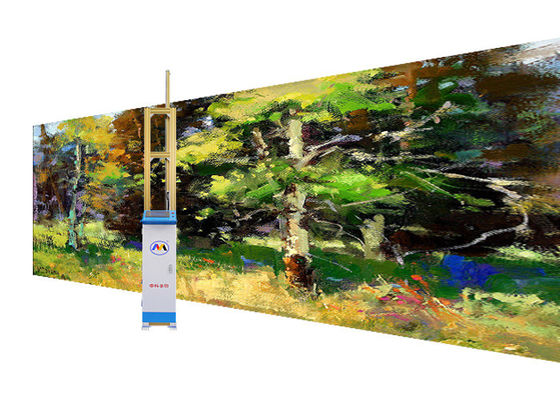
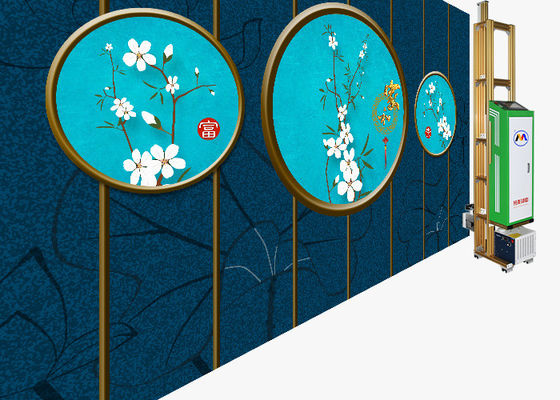
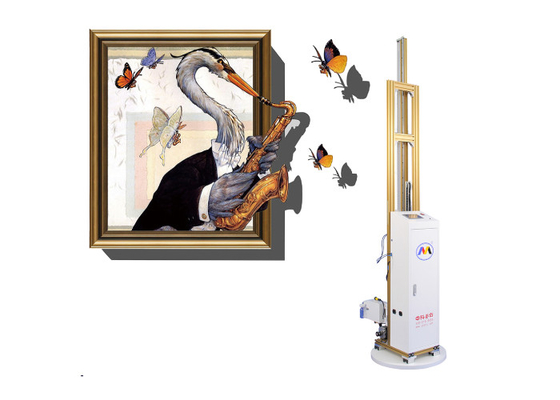
Four views are held for this reference and appear below at their native proportions, with the aspect ratio left as the media library recorded it. Any view can be opened in the enlarged viewer, and the arrow keys or the Previous and Next controls move through the set.


The four files above are the complete image set held against reference 13582614. Their names are unchanged from the media library, so each view can be traced back to the listing record without a separate index.
Independent manufacturer overview
The supplier entity behind this listing is presented on the platform as a manufacturer of digital wall printing technology. The facts below are what the storefront publishes about that company. They say nothing about which head set, ink set or rail length is inside the crate for reference 13582614, and they should not be read as if they did.
| Qualification aspect | Scope statement |
|---|---|
| Machine conformity | Assessed for the shipped model and the regulatory requirements of the destination market. |
| Ink conformity | Assessed separately from the machine, against the ink set supplied with the order. |
| Certificate applicability | Certification depends on the actual product model and target market. |
| Documentation control | Documents are issued against the delivered configuration schedule and the named contracting entity. |
A file held by the company is not a certificate for the machine in the crate. Ask for the document that names the ZK-Q7PLUS configuration being shipped and the market it is being shipped into, then check the nameplate against it on arrival.
Questions this configuration actually raises
The questions below follow from this particular designation rather than from the machine class in general. Commercial questions about payment terms, packing and shipping are answered in the quotation and are not repeated here.
The listing does not enumerate the functions, and it should not be assumed to be a full workstation. A panel of that size commonly handles job selection, positioning, basic colour or density adjustment and start or pause. Anything that needs a large preview, a profile edit or a colour measurement is normally done on a connected computer. Ask which of the two places each setting lives in, because that answer decides how the machine is operated on a scaffold.
Reproduction is a colour-management question before it is a hardware question. The machine has to print the profile it has been given onto the coating that is actually on the wall, and the comparison is made against the original under a stated light. That is achievable, but it is achieved by qualifying the coating and the file on a test area, not by relying on the machine's default settings. The listing gives no resolution figure, so the fidelity claim has to be tested rather than read.
Because this record publishes four identification values and nothing else. That is a property of the listing, not evidence that the machine has no resolution. Treat the absence as a task: request the figure, together with the print mode it applies to, in the quotation. A resolution number quoted without its mode is not comparable across machines anyway, since the same head prints at different effective resolution depending on pass strategy.
By quoting the platform reference with the model. The same model number appears on listings described at other heights and other resolutions, so the model on its own cannot pin down a shipped machine. Put reference 13582614, the model and the configuration schedule on the order as a single identification set, and check all three against the nameplate when the machine arrives.
A surface that takes the ink without pulling the carrier away from the pigment, a flatness regular enough for a stable head standoff, and a build-up solid enough that the rail does not settle during the job. For art work the extra requirement is visual: the wall must be uniform in absorption, because a patch that dries at a different rate shows as a tone difference in a gradient long before it would show in a logo.
No profile can be written for a wall that has not been built yet. What the supplier can provide is a profile for a named ink and a named coating, and that pair then has to be checked on the client's actual render or plaster. Plan for a test panel, a measurement and an adjustment before the production run, and budget it as part of the job rather than as a contingency.
An acceptance panel printed on the client's own wall build-up, viewed from the distance the artwork will be seen from, with the file name, the settings used, the standoff and the ink batch all recorded. On reproduction work the panel is the only artefact that settles a later disagreement about colour, because a wall cannot be re-measured after it has been painted over.
Verification before order and before dispatch
The checks below are the ones this listing makes necessary. They sit on top of the commercial, customs and payment checks that apply to any import order and do not replace them.
| Check | What this unit requires | Record to hold |
|---|---|---|
| Identification set | Model ZK-Q7PLUS, platform reference 13582614 and the configuration schedule all describe one machine. | Signed order specification |
| Control scope | The settings available on the panel are listed, and the ones that need a computer are known before commissioning. | Operator note from the handover |
| Artwork control | The file used for the acceptance print is named, with its profile, and retained by both parties. | Handover documents |
| Wall qualification | Absorption and flatness have been checked on the actual wall, not inferred from a sample board. | Site survey and test panel |
| Print envelope | Single-pass width and maximum travel are on the order, and the wall has been measured against them. | Order specification, measured survey |
| Image set | The four published views have been compared with the machine offered, so a substituted model is visible. | Listing record and arrival photographs |
| Conformity scope | The machine and ink documents name the shipped configuration and the destination market. | Certificate set for the delivery |
An unanswered line is a reason to ask a question while the quotation is open, not a detail to discover on the first morning of commissioning.
Direct from manufacturer
Direct from manufacturer
Direct from manufacturer